

The Genius from Torch Lake
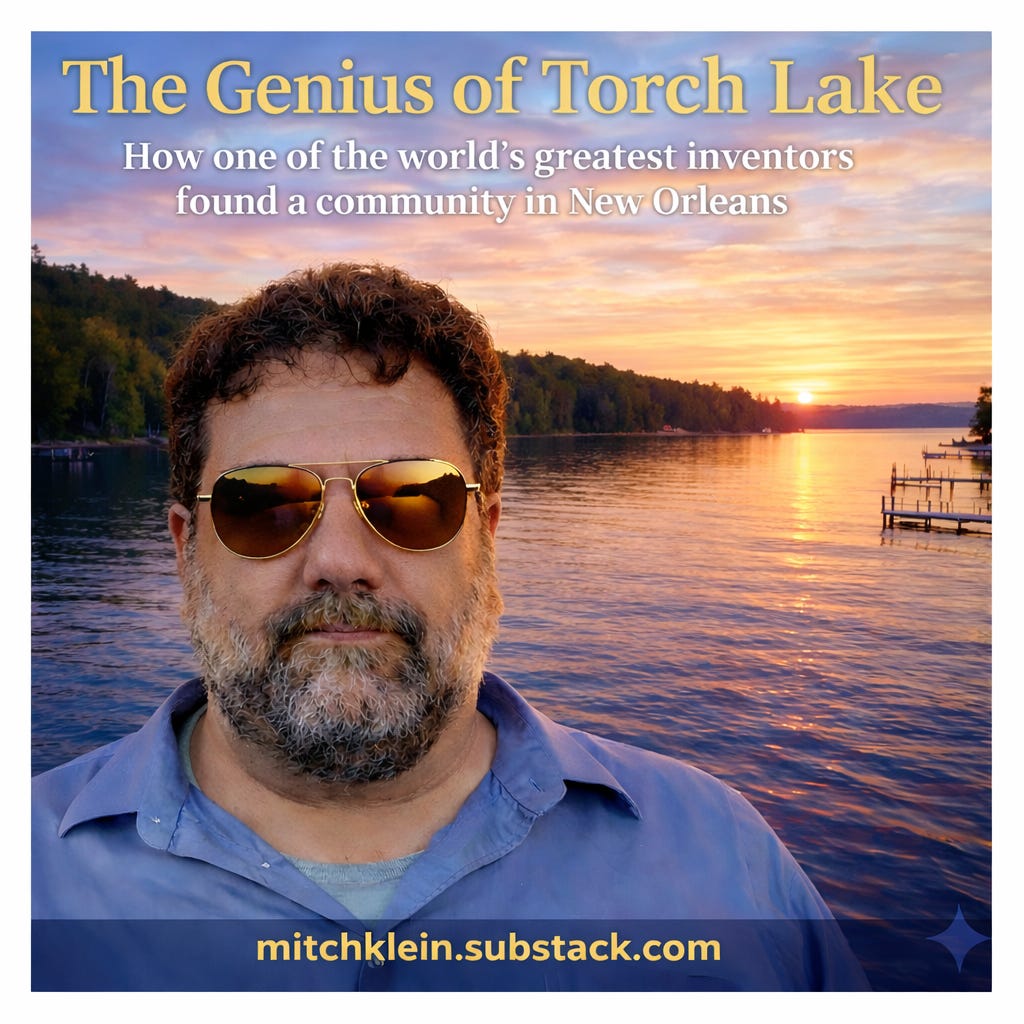
Correy Kowall, Chief Scientist and Inventor

I. The Question
I met Correy Kowall on Facebook.
He was living up on Torch Lake in northern Michigan. One of those places where the quiet isn’t peaceful so much as absolute. You can think there. You can also disappear.
He’d posted something in Hebrew about the universal means of production. I knew right away that this was someone I wanted to know.
Later, almost offhandedly, he asked a question on his feed:
“Why won’t anyone build my inventions?”
So I messaged him.
We started talking the way organizers and builders talk. We discussed the socialist Richard Wolff and other philosophers on YouTube. He told me about different bird species and their patterns. He explained to me his love for biology, neuroscience, and learning.
At some point, something clicked.
It reminded me of my dad.
My father was an inventor. I grew up around that kind of mind—the way ideas don’t arrive one at a time, the way the world never quite looks finished. When I recognized it in Correy, I didn’t feel surprised.
I felt recognition.
Before we ever met in person, Correy sent me a list.
Fifty-three inventions.
That’s not a normal number.
So I tested one. I called a heart surgeon—someone who had actually taken medical devices from sketch to operating room—and asked him to look at a robot Correy had designed to remove plaque from coronary arteries.
I’d survived a heart attack myself. Correy knew exactly what I’d care about.
The surgeon called me back and said it was excellent.
That should have been enough.
But medical devices weren’t my world. AI was.
And AI—whether the world knew it or not—was Correy’s world too.
He didn’t hesitate.
II. Growing Up in the Winter
Correy grew up moving constantly. His father was in the military. New schools. New towns. Gifted programs. Always ahead. Never settled.
While other kids were learning long division, Correy was designing systems—ships, machines, entire structures—fully formed in his head.
“I could see them,” he told me. “I just assumed everyone else could too.”
By twelve, he had read nearly every book in the local library. He calls it a gift and a curse.
“The gift is seeing patterns years before anyone else,” he said.
“The curse is no one believes you until they catch up.”
At fifteen, after his parents divorced and he returned to northern Michigan, he found a book in a discount bin, Connectionism, an old word for neural networks. The field hadn’t even settled on a name yet.
This was the AI winter, thanks to Marvin Minsky; the field was on hold. Funding collapsed. Labs shut down. No roadmap. No real community.
Correy wasn’t thinking about products. He wasn’t thinking about language.
“Language felt trite,” he told me. “Surface behavior. Not the thing itself.”
III. Building Without Permission
In his mid-twenties, Correy returned to school and landed at Northern Michigan University. Not a prestigious research institution—but it had one accidental advantage: it didn’t claim intellectual property on student work.
So he built.
He scavenged machines, cleared out an unused robotics lab, and assembled a Beowulf cluster the university barely knew existed.
“I had experiments I needed to run,” he said. “So we built the infrastructure.”
He wrote simulations for self-replicating vehicular robotics. He published at a school where almost no one published. There were newspaper articles. People noticed.
After college, he moved to Marquette and lived with his then-girlfriend into a giant yellow house everyone called the Fairy Castle.
He worked at UP Fab. He was restless.
“I didn’t want to work for a mine,” he said. “I didn’t know what I was supposed to do with myself.”
Around that time, Correy learned that Jürgen Schmidhuber was giving a talk at Harvard.
Schmidhuber wasn’t an abstraction to him. He was an AI pioneer, someone Correy had been reading and writing to for years.
So he showed up.
They met at Harvard.
Schmidhuber listened. Asked questions. Then asked one that mattered.
Did Correy have money?
He didn’t.
There was a stipend. Not much. Not security. But it was real.
That was enough to open the door.
IV. Loss, Drift, and the Bitter Pill
Correy went to do AI research at IDSIA in Switzerland with Schmidhuber. Developmental systems. Cognitive robotics. He was working with people he’d read about for years.
Ideas moved fast. Credit didn’t.
“My ideas circulated,” he told me. “Ownership was… unclear.”
When he left, he didn’t leave with a career.
He left with clarity.
And the bitter pill of having met his heroes.
After that, Correy went back to Michigan. He wasn’t sure how to stay in the field or what to do next.
For years, he lived with his mother. She wasn’t well. She wasn’t a collaborator. She didn’t push the work.
But she understood his mind because she was his mom.
“She knew how my mind worked,” he said. “She didn’t need it explained.”
He kept inventing. Dozens of ideas. No builders.
Then his mother died.
The loss was quiet and total.
Not long after, COVID hit.
Correy got sick. Badly. He nearly died.
Grief stacked on grief. Time collapsed.
For a long while, he barely moved.
During that period, he met a woman online. They talked for hours every day. The connection mattered because it reintroduced expectation—you’re still here, so you still have to be someone.
He was in love, so he decided he'd better get up and move.
V. Why I Knew I Could Build This
By the time Correy and I really connected, we had known each other for months.
This wasn’t fandom. And it wasn’t curiosity.
I’m an entrepreneur, but more than that, I’m an organizer. I know how to start from zero. I know how to survive on low money. I know how to recruit without brand power and keep things alive when there’s no safety net. I’m often willing to put up with difficult situations that others won’t to get something built.
I’ve built political organizations, companies, data systems, and infrastructure projects in hostile environments. I know how teams break. I know how they hold. And I know how rare it is for real invention to survive contact with the world.
So when I looked at Correy, I wasn’t asking whether he was brilliant.
That part was obvious.
I was asking something else:
Could I build a structure around this mind that would let it survive?
AI had broken open again. The window was real. If Correy was ever going to contribute something that mattered to humans—not markets—this was the moment.
He decided to re-enter the field before April 2023.
April wasn’t the awakening.
It was the execution.
VI. April 2023: Re-Entry
In April of 2023, after knowing Correy for several months, I flew him down to New Orleans to meet with us. Not for a demo. To sit in a room and see whether this could actually work.
Around the same time, I called an old college friend, Damon Kirin.
Years earlier, Damon had told me: If you ever really need help, call me.
I called.
Damon put up the money and became involved in the project, helping to raise some money from family and friends.
That part matters. Capital protects work long enough for it to exist.
That same month, Correy did the hardest thing first.
He didn’t invent a system.
He studied the field.
For roughly thirty days, Correy read everything—Transformers, attention, scaling laws, hallucinations, failure modes.
“I didn’t want narratives,” he said. “I wanted mechanisms.”
That month produced clarity.
Not ATOMIC.
ATOMIC came after that month.
ATOMIC is all about the theory of mind and building a smaller, better, faster, and less expensive form of AI. Most importantly, the goal was to stop hallucinations, one of LLMs most persistent challenges.
After the field was mapped.
After the failure modes were understood.
After we knew what not to build.
Then we began building ATOMIC.
VII. The Long March From Idea to Reality
What followed wasn’t clean.
We struggled to find the right muse for Correy—the right configuration of people who could take extremely abstract mathematical and system-level ideas and help turn them into reality without distorting them.
That’s harder than it sounds.
We marched through the real steps. Filing patents. Building architectures. Hiring people. Sometimes, letting people go. Adjusting roles. Rebuilding trust. Doing the unglamorous work that never shows up in demos.
Some people didn’t cut it.
But before long a core team stuck.
Several foundational people grew with the company—learning how Correy thinks, learning how the system works, learning how to operate at that level. The work deepened. The structure held.
And then Zach arrived.
VIII. Translation and the Team
The hardest problem wasn’t invention.
Correy is constantly inventing.
It was translation.
That bridge was people like Zach Christiansen.
Zach can listen to Correy explain something fully formed in his head and extract its structure—what was core, what could change, what could not. He turned invention into architecture that other engineers could actually work with.
That was new.
For the first time, Correy’s ideas didn’t just circulate.
They stuck.
Once the work became shareable, serious people could commit.
IX. Scott
As the team grew, leadership mattered.
About 18 months ago, I was fortunate to meet Scott Kauffman in California through my friends the Pichinsons while I was out there fundraising.
Scott became our leader and Chairman of the Board.
When Correy first met him, he paused, thought for a moment, and said Scott was “adequate.”
Coming from Correy Kowall, that was a very high compliment.
Scott has a rare ability to work with people without flattening them. He holds the center without dominating the room. Most importantly, Correy trusted him.
That trust changed the trajectory of the company.
X. The Work
Today, more than twenty engineers, researchers, and operators work on Correy’s inventions every day.
That number matters because it represents commitment—people choosing this work over easier money and safer paths.
For what has been invested, the depth of this lab is unusual. We have the challenge of being in New Orleans, where the support structures of companies like ours are far and few between.
We’re building systems designed to align better with human needs and waste far less power. Systems that can be inspected, controlled, and improved without lying to themselves.
This is not “scale and pray.”
This is engineering.
XI. The Blessing
There’s one last thing worth saying.
Meeting Correy has been a blessing to me too.
I’ve never learned this much from anyone in my life. This has been one of the greatest friendships I’ve ever had.
He can be cantankerous. He can be exhausting.
But I love him. And he’s usually great fun.
Correy now lives in New Orleans, in a little yellow house on Burgundy Street. Every day, our team continues to turn his ideas into futuristic products.
Ideas don’t usually get that chance.
People don’t either.
Everything else is commentary.
Love it so much! Great job, Mitch. So glad to be a part of this company.
Phenomenal narrative about recognizing raw intellect and building the infrastructure to let it thrive. The part about translation really landed for me because alot of people dunno that bridging abstraction to implementation is often harder than either one alone. Schmidhuber at IDSIA was the real deal during the AI winter and the fact that Correy orbited that circle early explains so much about the architectural depth in ATOMIC.