

The Enforcement Economy
What happens when contracts matter more than people

There is a moment before every real crisis when everything still technically works.
The rules are still on the books.
The press is still publishing.
The hearings are still being held.
And yet, if you know how to look, you can see what’s really holding the system up.
Money.
Americans like to believe that when the truth becomes obvious enough, the system will correct itself. If enough data piles up, someone will step in.
That story is comforting.
It just isn’t true.
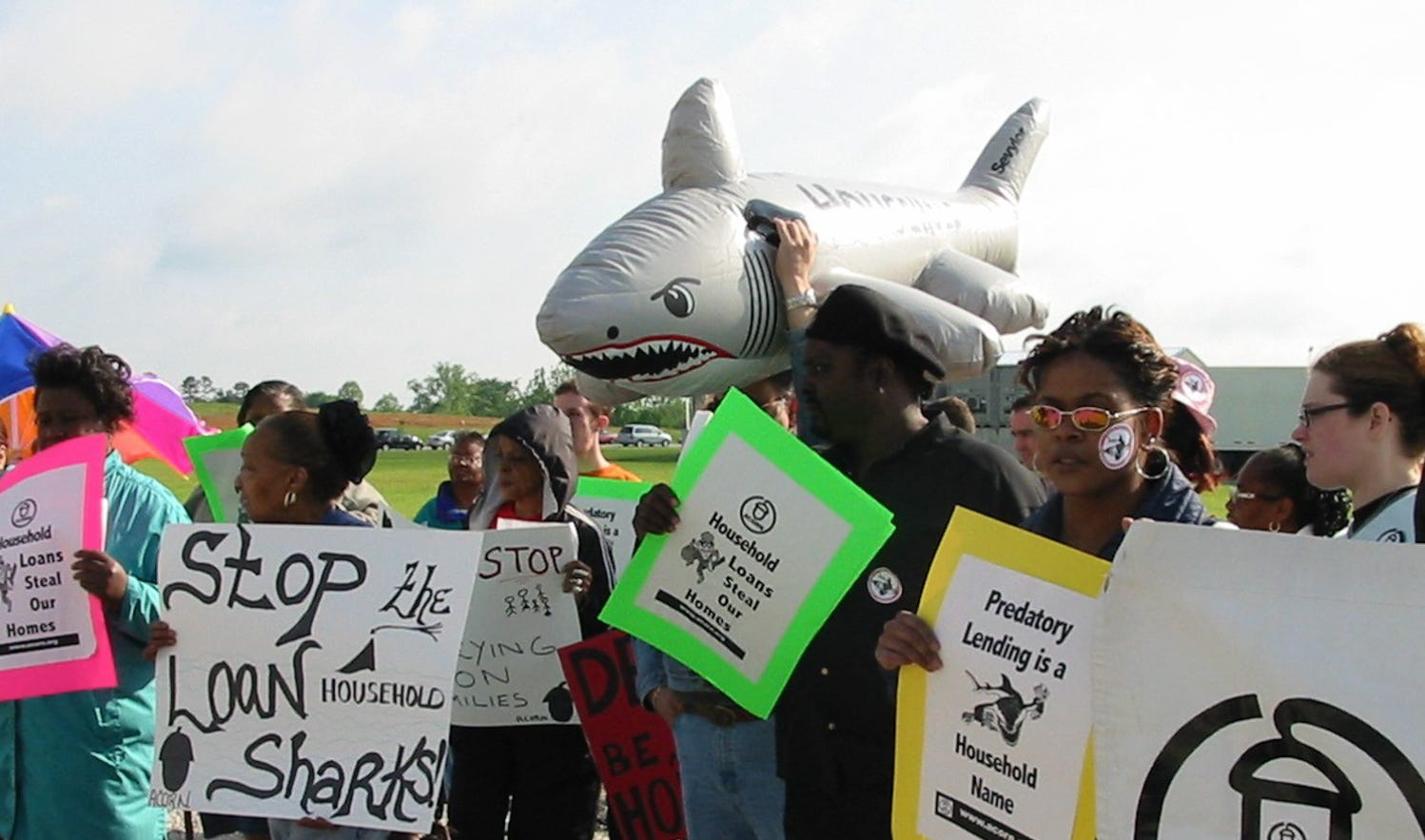
I learned that in Baltimore in the early 2000s, when I was the head organizer for Maryland ACORN, and whole neighborhoods were being hollowed out by predatory lending in real time.
This wasn’t abstract. You could walk blocks on the west side and watch it happening: for-sale signs nailed into plywood, windows boarded, families gone. Not because people were reckless — because they were targeted.
ACORN tracked the loan terms — with help from a few allies, but mostly through the work of grassroots organizers who had to figure it out themselves. We collected mortgage contracts, mapped balloon payments, documented teaser rates, and watched brokers, landlords, and lenders steer Black and working-class families into loans designed to explode. The numbers were screaming long before Wall Street admitted there was a problem.
So we went to Annapolis.
We brought the people who were actually being hit by the busload.
People whose homes had been flipped out from under them.
People trapped in adjustable-rate mortgages they could never afford once the clock ran out.
People were staring down foreclosure and homelessness because someone had lied to them.
We brought their loan documents.
Their foreclosure notices.
Maps showing entire Baltimore neighborhoods being hollowed out.
We filled the hearing rooms. We flooded the hallways. We put faces in front of numbers.
And behind closed doors, something else was happening.
I remember sitting in the office of Delegate Maggie McIntosh — a powerful Baltimore Democrat who was supposed to be on our side — as she slid a stack of papers across her desk. It was the mortgage industry’s version of a predatory-lending bill: reform in name, protection for lenders in practice.
I didn’t have to guess where she stood. She told me directly that she was backing the industry’s version — the one that stripped out the protections homeowners actually needed.
Public records from the 2002 Maryland session later confirm my memory. McIntosh was a principal sponsor of what community groups called the “Loan Shark Protections and Immunity Acts” — bills designed to block cities from passing their own anti-predatory-lending laws.
A few days later, I met Senator Thomas Bromwell, the affable, charismatic chair of the Maryland Senate Finance Committee. The kind of guy who makes you feel heard. I thought we’d actually connected and that he was going to support model legislation to curb lending abuses. Then he killed the bill.
Not because the data was wrong.
Not because the harm wasn’t real.
But because the campaign-finance money was louder. The lobbyists filled the hallways. The outcome was already priced in.
Those industry bills weren’t neutral. They froze poor cities while abusive lenders kept running. With no real regulation, Baltimore became ground zero for the subprime crisis in America.
I watched it happen. Lip service became a shield. The grift wasn’t hidden — it was normalized.
I remember signing up an East Baltimore ACORN member who was losing her home to Household Finance. Not because she bought a boat. Not because she gambled. Because she had financed a $500 meat delivery that got tied to her mortgage. That was enough to destroy her.
Household Finance eventually collapsed because campaigns like ours forced its practices into the open through lawsuits, regulatory complaints, and direct action. We actually won that fight. But it was the exception. The industry survived. It morphed. It got new rules and a new watchdog for a while — the CFPB — which was just kneecapped again this year by DOGE.
Families lost their homes by the millions long before Washington called it a crisis.
The damage didn’t start in 2008.
It just became impossible to ignore in 2008.
And the lesson the system learned was not “don’t do this again.”
It was: this is survivable.
Banks paid fines. Executives kept their fortunes. Public money made the institutions whole.
The real subsidy went to the banks.
The wreckage stayed in Baltimore.
That lesson never went away.
If this kind of work matters to you — the kind that follows the money and tells the truth even when it’s uncomfortable — this is how it survives.
Substack doesn’t fund investigations. Readers do.
You can become a free or paid subscriber here. That’s how this stays independent of the money it’s calling out.
The enforcement economy
There is now a new, multi-billion-dollar economy being built around immigration enforcement.
Detention beds.
Transport contracts.
Surveillance systems.
Private prisons.
Defense contractors.
The agency grows when enforcement grows.
The companies get paid when more people are locked up.
This isn’t just law enforcement. It’s an industry.
And just like the mortgage machine before 2008, it is politically protected, and its wealth depends on the misfortune of others.
The same corporations that run detention centers and deportation flights have poured millions into Trump-aligned super PACs, party leadership funds, and the 2025 inauguration. Oh, and they’ve donated to Democrats, too. That money doesn’t buy speeches. It buys policy. When the companies that get paid per detainee are underwriting the politicians who decide how many detainees there will be, cruelty stops being a scandal and becomes a revenue model.
Louisiana, where the cages are
Louisiana didn’t become central to immigration enforcement because migrants are crossing the border here.
It became central because it is safe for detention companies.
GEO Group and CoreCivic built their biggest facilities here and signed ICE contracts that guarantee full beds. Rural parishes became detention hubs. Towns became dependent on prison payrolls. Counties started budgeting around incarceration.
So enforcement stopped being about immigration and started being about keeping the lights on and a jobs program for economically distressed constituents.
Once a place becomes economically tied to cages, policy stops being about law. It becomes about contracts.
That’s how cruelty gets locked in.
The violence was already known
Years ago, the federal government studied Border Patrol and immigration-agent shootings.
What it found was chilling.
Agents were repeatedly stepping into the path of moving vehicles and then using that position to justify deadly force. Even when investigators said the agents created the danger, the shootings were cleared.
The behavior was documented.
The risk was known.
Nothing changed.
They rewrote policies. They changed some wording. But they left the incentives intact.
Then enforcement ramped back up.
In 2024, fatal shootings by immigration agents were rare enough to shock people. By mid-2025, they weren’t. Agents fired their weapons in at least sixteen incidents in a single surge. People were killed. Others wounded. Videos contradicted official stories. Local police pushed back.
And Congress did nothing.
No hearings.
No subpoenas.
No accountability.
They stepped aside and let it run.
When contracts rule, people die
At the same time, ICE detention deaths hit their highest level in decades. People died waiting for care. Solitary confinement has been used on thousands of non-violent, civil violators in detention.
Thousands of armed ICE agents have deployed into American neighborhoods — not as neutral civil servants, but as the workforce of a detention industry.
When a horrific shooting happened, nothing paused.
It accelerated.
Because pausing would break contracts.
And breaking contracts would lose money.
This isn’t chaos.
This is what a corrupt campaign-finance and lobbying system looks like when it’s functioning.
This is the danger zone
Not tanks.
Not martial law.
Not collapse.
Paperwork.
Budgets.
Signed agreements.
A normal day at work.
It looks like Congress knows something is wrong and is choosing not to stop it.
It looks like families are being torn apart while corporations get paid by the body and the bed.
When politicians raise their money through super PACs and donor networks funded by companies that profit from incarceration and surveillance, policy stops being about what’s right.
It becomes about what pays.
That’s how predatory lending survives and sadly is making a return in America.
That’s how mass detention survives.
A system that lets giant financial interests buy influence will keep producing harm — quietly, legally, procedurally — until the damage is too big to hide.
And when it finally breaks, the people who cashed the checks will not be the ones who suffer most.
They never are.
This is reader-supported work. If you want it to keep going, subscribing is how you make that happen.
"The cause is because"! Poor people are diminshed because they are deprived. You are on point in highlighting and emphasizing the impacts of corporate greed and preditory contracts upon the poor. Poverty and status issues dominate the lives of immigrant populations, so they presently are a most vulnerable target for predatory and incarceration contract practices. Polititions therefore especially find excuses in capitalism for their own incompetinces and impotence regarding meaningful fighting for change and justice!