

Staying Close to the Keys
Adam Kelly, One of New Orleans' greatest musicians talks creativity

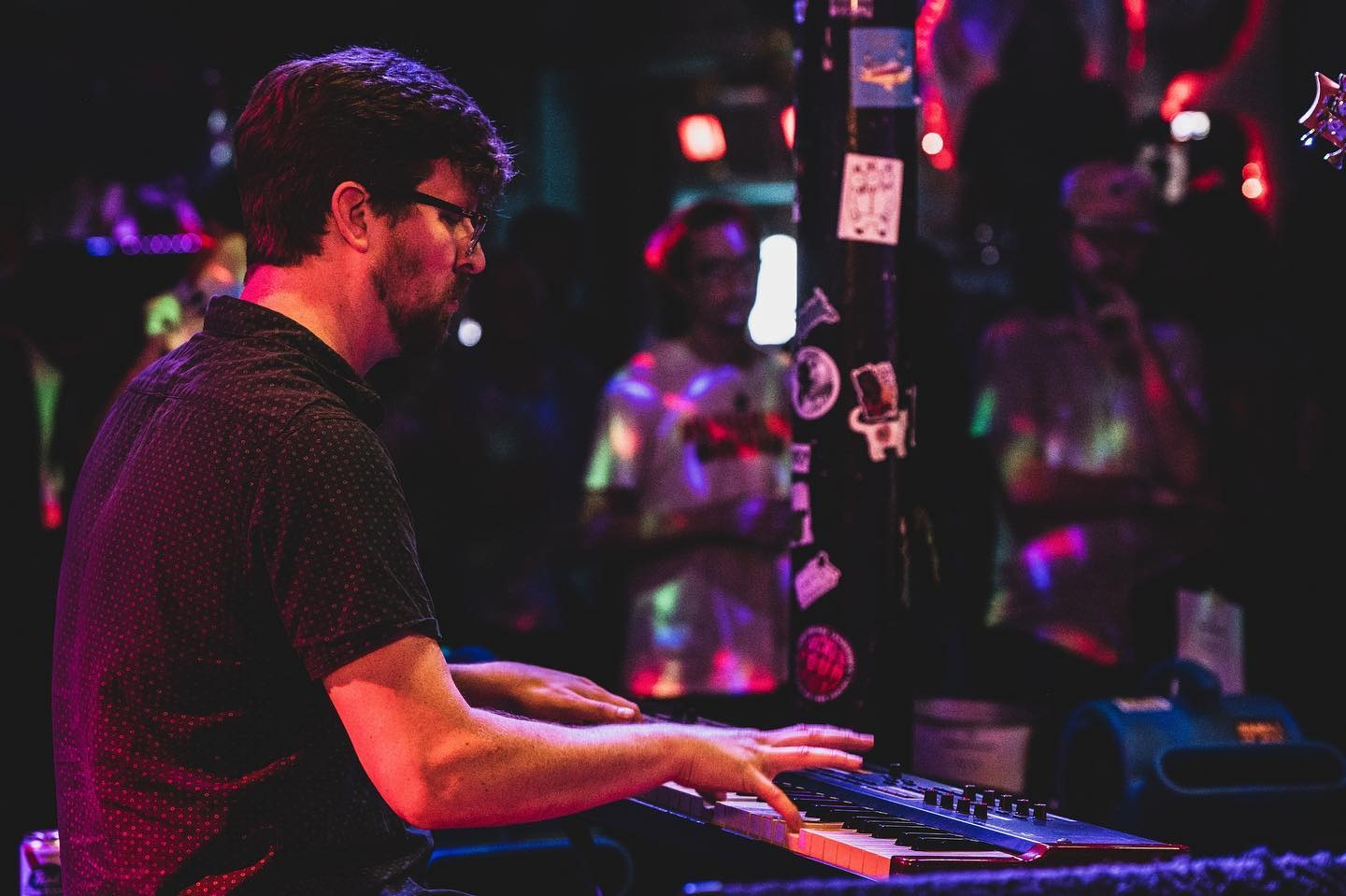
I’ve spent a lot of my life seeking out creative people.
Not as a strategy. Just by paying attention to who keeps showing up, who stays inside the work long enough for something real to happen. New Orleans rewards that patience by allowing those who live here to connect with so many hard-working artists and musicians.
Adam Kelly is one person who constantly works at it.
At any given time, Adam is in six or seven bands around town, all drawing from the same rotating pool of forty or fifty musicians who love improvisational (usually jam band) music. I’ve known him for years. I’ve stood next to a lot of stages watching him play keyboards, and I can feel my brain melting a little bit almost every time. The music will frequently find a place it didn’t know it was heading toward, and Adam’s already there. Shaping it.
For me, seeing live music resolves my anxiety. This kind of music—improvisational, searching, unhurried—lets my mind see alternatives. New ways of looking at things. There’s nothing like watching Adam delightfully work the keys, tickling different parts of my mind as he makes his way through a forest of sounds. The stress of life releases its grip. Problems I walked in with start to loosen.
That’s what this music does. It rearranges something.
Adam picked up piano in 9th grade. Everyone around him was grabbing guitars. He wanted a different lane. The keyboard felt open—less crowded, less prescribed. That decision stuck.
Phish was his foundation. He says, it was “such an eye-opener that keyboards could be part of rock music, like, as a featured instrument.” That changed how he saw the instrument. Not as decoration. As something that could carry the music.
His ears kept widening. Ben Folds. Pink Floyd. Then funk in college, where he discovered John Medeski—someone who gave him “the understanding and confidence to really lean into improvisation… not being afraid to play dissonant or weird, or search for a long time to find something.”
He listens to Phish for the heart, Radiohead for the gut, Medeski Martin for the brain. His favorite parts of Phish are when they get dissonant or spacey.
That range shows up in how he plays.
If you’re enjoying this, subscribe. It’s free and it helps me keep writing. Please consider becoming a paid subscriber to advance this work.
Cardboard Cowboy is the band he’s played with the longest. Years of learning how to listen without talking about it. Nobody’s rushing. Nobody’s filling space just to fill it. The band trusts itself. Its one of the best, most polished bands in New Orleans.
Then there’s Phoush, the New Orleans Phish tribute band.
For Adam, it’s a full circle thing—from discovering that keyboards could carry rock music to now being comfortable enough to actually play it. Phish music is hard. Really hard. But last year Phoush played constantly and pushed themselves. They leveled up.
Blake Quick sings and plays guitar in Phoush. Filling Trey Anastasio’s shoes is no small thing. Some people think Blake sounds better than Trey.
I’m one of them.
Both bands have ambitions to take it further. Watching them now, it’s clear they’ve crossed into something really spectacular.
Adam is honest about the work underneath. Getting through something really difficult without mistakes—that’s what gives you the confidence to take risks in the jam.
Discipline isn’t the opposite of freedom. It’s how you earn it.
That same posture shows up somewhere you wouldn’t expect: a tabletop role-playing podcast Adam runs called Strange Table Fellows.
Adam runs it. He builds the world, sets the story in motion, then watches his players blow it all up. He walks in with an outline. He has no idea what the protagonists will actually do—because that’s not his call. The players decide. His job is to adapt in real time, to react without stomping over the moment.
“The classic thing of improvisation is yes, and—what can I do to build upon what’s happening right now? What can I add to elevate it?”
That’s how he learned to be in a band. That is how Adam learned to improvise with other people. Music taught him how to hold a story loosely enough that other people can live inside it.
His newest musical project, Phantom Volumes, is more composed but still improvisational. More inward. Instrumental. Keyboards out front, Adam is 100 percent of the star of this band. He doesn’t write lyrics—never has. He’s trying to evoke a story from the keyboard rather than tell you what it is with words.
I’ve come to believe that creativity is the highest purpose.
Not as output. Not as content. But as a way of staying awake. Paying attention. Making something real with other people and letting it change you a little is a way of staying healthy.
That’s why I seek out people like Adam. That is why I show up for them. That is why I support the ones who keep doing the work without asking for permission or applause.
That’s how a city like New Orleans stays alive despite everything working against it.
Adam at the keys. The band is listening.
And improvizing.
If this resonated, consider becoming a paid subscriber. It supports independent writing and keeps this space honest.