

Standing Reserve
The richest man on earth doesn’t see a country. He sees inventory — land, oil, compute, knowledge, government, you. How the world gets turned into supply, and the one move left to stop it

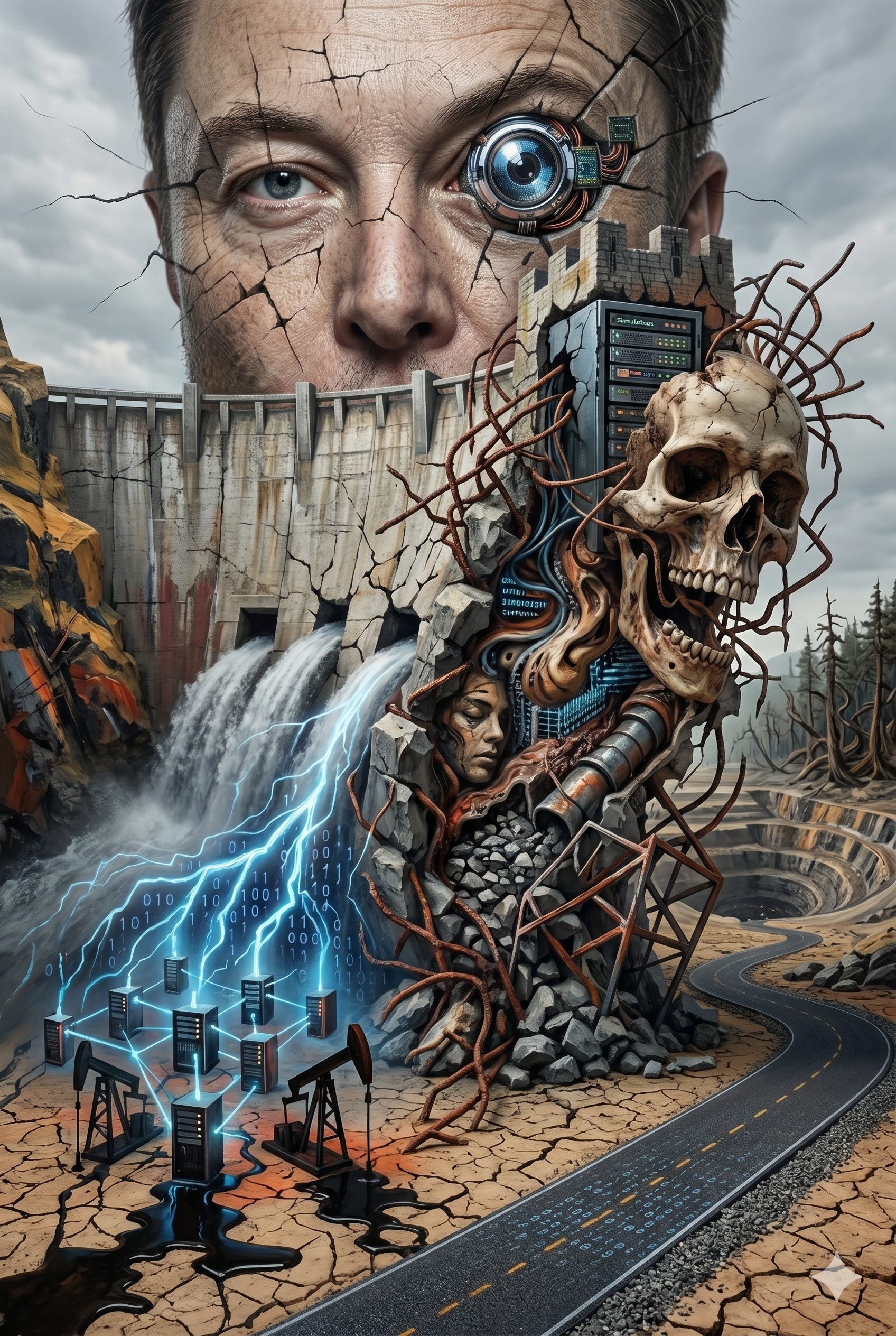
Martin Heidegger said that once you build a dam, the river stops being a river.
It becomes something else: a supply of power, on call, waiting. He called that condition standing reserve — the moment a thing stops existing for its own sake and starts existing only as a resource to be drawn down. The river doesn’t flow anymore. It delivers.
And here is the part that matters. Once you learn to see that way, you can’t stop. The forest becomes board-feet. The mountain becomes ore. The ground becomes oil. The worldview spreads until it can’t tell the difference between things anymore — a barrel of crude, a server rack, a national power grid, a database of a hundred million people’s private lives, a human being at the end of a phone line. To the extractive eye, they are all one category. Input. Reserve. Yield waiting to be booked.
The danger, Heidegger wrote in 1954, was the day human beings looked at the same way the dam looks at the river. Not as people. As supply.
Seventy years later, there’s a man who looks at all of it — land, oil, compute, knowledge, government, you — and sees only resource. This is the story of what he sees when he looks at the world, told in three acts, because three philosophers each gave us a word for one piece of it.
Act One: The Fake
Jean Baudrillard said the most dangerous lie isn’t the one that hides the truth. It’s the simulation — the copy of something that never existed, the fake so complete there’s no original underneath it.
Watch one happen.
In January, Nvidia “sold” $5.4 billion in AI chips to a company called Valor — a shell with no employees, built to hold the title while the chips run Grok inside Elon Musk’s xAI. Nvidia booked the whole $5.4 billion as revenue. The stock jumped.
Then the catch: Nvidia had quietly put $1.9 billion of its own money into Valor. It sold chips to a buyer it funded, and called it a sale. Apollo wrapped $3.5 billion of the debt into securities and sold them to Athene — its own insurance company — which sells annuities to retirees and keeps $74.2 billion in U.S. reserves while parking $217 billion offshore in Bermuda, beyond standard American oversight. More than a third of its portfolio has no observable market price. Nobody knows what it’s worth. The whole thing runs at roughly 16:1 leverage.
Michael Burry, the investor who called 2008, read the filings and said one word: " Fugazi. Fake.
That’s the simulation. A sale that simulates a sale. Revenue that simulates revenue. An economy performing the gesture of creating value while quietly moving the risk somewhere it won’t be seen — into the savings of people who never heard the deal existed. Nothing real was made. The map got drawn over an empty place, and everyone agreed to call it territory.
Act Two: The Reserve
Now Heidegger, and the long list of everything getting converted.
Start with the oldest resource of all. Louisiana has been an extraction colony for a century — oil pulled from under the marsh, the marsh itself sold off barrel by barrel, the land treated as a thing to be drained and left. The data center boom is the same logic with a new commodity. The chips need power, so in Louisiana the Public Service Commission voted 4-1 to fast-track gas plants for them and let ordinary ratepayers carry up to 75% of the cost. The one dissenter said it plainly: “I feel we did a disservice to the people of Louisiana.” Oil under the ground, electricity through the wire, the same state, the same people, drawn down on call.
Then compute the new oil. Five companies poured over $400 billion into data centers last year. In Virginia, the racks already eat a quarter of the state’s electricity. The machine’s hunger is now large enough to bend a national grid — and the grid, too, becomes a reserve, a thing that exists to feed the servers rather than the homes.
Then knowledge — and this is the strange new one. An AI model is a strip mine for everything humans have ever written, said, or made. The collected knowledge of the species was scraped and refined into a product. And it doesn’t stop at the public record. DOGE pulled NUMIDENT, the file holding every Social Security number ever issued, plus the Death Master File — records on hundreds of millions of Americans, living and dead. A whistleblower says a staffer copied the data onto an outside server. Your identity, your history, your life on paper: ore to be processed.
Then humans. You’ll never buy a SpaceX share — but when it merges with xAI into a $1.25 trillion company and lists on the market, every index fund and pension must buy in, by rule, by weight. Your retirement gets conscripted into the bet, whether you ever hear its name. You didn’t pick the stock. The stock picked you. And at the bottom of the same machine: the agency that mails Social Security to 71 million people, cut to a 50-year staffing low, half its callers hanging up before a human answers. People are reduced to throughput, then to a backlog, then to a number that goes down when you cut staff.
Then, the government itself — the most audacious conversion. Musk spent close to $300 million electing a president, took a federal badge, and his companies pulled roughly $22 billion in contracts from the agencies he was meant to oversee. The same hand on both sides of the table. The state stops being a referee and becomes a resource — a faucet of contracts to be opened toward yourself.
And finally the city. New Orleans “won” a free Boring Company tunnel — the one whose Las Vegas dig left two firefighters chemically burned and a worker’s pelvis crushed, whose fines vanished the day after the company called the governor. They want to dig it under a city below sea level. As a gift.
Land. Oil. Compute. Knowledge. People. Government. A city. None of them exists for their own sake anymore. All of them are delivering.
Act Three: The Collapse
The last philosopher is Joseph Tainter, who spent his life asking why civilizations fall.
His answer wasn’t barbarians or plague. It was arithmetic. Every society runs on energy. It spends that energy building complexity — institutions, systems, machines. For a while, the complexity pays off. Then the returns shrink, the energy costs climb, and one day the society is spending more to hold itself together than it gets back. It can’t feed the machine it built. So the machine sheds pieces. That shedding is what we name, afterward, collapse.
We are feeding a machine of historic appetite. Five companies poured over $400 billion into data centers last year. The energy to run them gets pulled from the same grid that heats homes and runs hospitals. The money to build them gets pulled from retirements that were promised to stay safe. The return flows up. The cost flows down. And the men at the top have engineered the whole thing so that when it breaks, the people holding the loss are the ones who were never in the room.
Rome didn’t fall in a day. It debased its coins, thinned its services, and farmed its functions out to private men who took their cut and left. Nobody gets a memo. They just noticed the roads getting worse, the water pressure dropping, and the line nobody answered.
A quick, honest interruption. Every institution in this story got captured the same way — somebody paid for it. The grid, the agencies, the contracts, the coverage. This newsletter is built so it can’t be. No ads, no sponsors, no billionaire on the masthead. It’s funded by readers, which is the only reason I can name the names in this piece without checking who I might upset. If you want this kind of reporting to keep existing, that’s the whole ballgame: become a paid subscriber. It’s how the lights stay on.
Musk didn’t invent any of this. The financiers ran the simulation before he arrived. The politicians sold the grid without his help. He’s simply the one man standing on every corner at once — which makes him the clearest place to watch a machine that runs with or without him. Take him out, and the deals work exactly the same.
That’s the part that should keep you up. Not a man. A way of seeing. A worldview in which the river is power, the forest is lumber, the oil is yield, the data is product, the city is real estate, the government is a faucet — and you are reserve, capital on call, waiting to absorb a loss you never agreed to hold.
The genius of it, and the horror, is that the extractive eye makes no distinctions. It looks at a barrel of crude and a human life and the private records of hundreds of millions of people and sees the same thing: supply. That flattening is the whole engine. It is what lets a man treat a country the way a refinery treats a field.
Heidegger thought there was a way back. The same capacity that lets us reduce the world to resource, he said, is the one that lets us see it whole again — if we choose to look.
So look. The richest man on earth will tell you he’s building the future. Read the filings instead. What he’s building is a way to keep the gains and hand you the risk, and call it progress while he does it.
A river doesn’t get a say in becoming a battery. The oil doesn’t. The land doesn’t.
You still do.
And the simplest way to use it: don’t let the one thing they can’t buy go quiet. Light the Way is reader-funded — no ads, no sponsors, nobody who can call and ask me to soften a paragraph. If this piece told you something the captured outlets won’t, subscribe, and share it with one person who needs to read it. Free keeps you in the room. Paid keeps the room open.
That’s the whole ask. The rest of this newsletter is the work.
Sources
Valor / Nvidia / xAI (Burry)
24/7 Wall St. via Yahoo Finance — Athene $74.2B reserves vs. $217B Bermuda, 34.7% Level 3, 16x leverage. https://finance.yahoo.com/markets/stocks/articles/michael-burry-just-called-nvidia-154541018.html
Crypto Briefing — $1.9B Nvidia equity into Valor; $3.5B Apollo debt to Athene. https://cryptobriefing.com/nvidia-valor-gpu-sale-burry-scrutiny/
TheStreet — full revenue recognition; Burry not alleging fraud. https://www.thestreet.com/investing/stocks/michael-burry-doubles-down-on-nvidia-and-stock-market-message
SpaceX / xAI / X merger and IPO
CNBC — $1.25T merger, IPO timed for mid-2026. https://www.cnbc.com/2026/02/03/musk-xai-spacex-biggest-merger-ever.html
CNN Business — xAI owns X; orbital-data-center rationale. https://www.cnn.com/2026/02/02/tech/spacex-acquires-xai-elon-musk
(The IPO/index-capture point is a structural argument about how benchmark-tracking funds operate, not a disclosed plan.)
AI energy
IEA — $400B+ capex by five firms, +75% in 2026, 17% demand growth vs. 3% global. https://www.iea.org/news/data-centre-electricity-use-surged-in-2025-even-with-tightening-bottlenecks-driving-a-scramble-for-solutions
Pew Research / EPRI — Virginia 26% of state electricity (2023). https://www.pewresearch.org/short-reads/2025/10/24/what-we-know-about-energy-use-at-us-data-centers-amid-the-ai-boom/
Louisiana / Lightning Amendment
Louisiana Illuminator — 4-1 vote; Coussan/Lewis. https://lailluminator.com/2025/12/19/electricity-data-centers/
WWNO — Lewis “disservice to the people of Louisiana.” https://www.wwno.org/coastal-desk/2025-12-17/in-tense-meeting-louisiana-psc-fast-tracks-pathway-for-large-projects-like-data-centers
The Lens — 75% ratepayer exposure. https://thelensnola.org/2026/02/18/louisiana-lightning-amendment-ai-data-centers-ratepayer-costs/
DOGE / Social Security
EPI — 50-year staffing low; half of callers hang up. https://www.epi.org/blog/what-is-doge-doing-to-social-security/
Brookings — NUMIDENT, restraining order. https://www.brookings.edu/articles/doge-is-disrupting-social-security/
HuffPost — O’Malley “sabotage.” https://www.huffpost.com/entry/social-security-missed-benefit-payment_n_67c5d849e4b05a517aba7be2
SpaceX contracts
Fed-Spend — ~$22B lifetime; FAA/Starlink conflict; “rule on his own.” https://fed-spend.com/blog/spacex-government-contracts-nasa-dod-space-force
CNN Politics — Musk spent $290M+ on the 2024 election. https://www.cnn.com/2025/02/01/politics/elon-musk-2024-election-spending-millions
Boring Company / New Orleans
Fortune via Las Vegas Sun — governor contact, rescinded citations, deleted records, crushed pelvis, “daily” burns. https://lasvegassun.com/news/2025/nov/13/fortune-nevada-gov-lombardos-office-intervened-to/
The Nevada Independent — ~800 violations; two firefighters. https://thenevadaindependent.com/article/federal-osha-officials-ok-justification-for-dismissal-of-citations-issued-to-boring-co
NOLA.com / The Advocate — NOLA Loop winner; Convention Center–to–Hyatt route. https://www.nola.com/news/business/new-orleans-boring-company-elon-musk-tunnel-vision/article_d22a2e14-1c75-40ca-bed8-ffea0956118f.html
Philosophy
Martin Heidegger, “The Question Concerning Technology” (1954) — Gestell (enframing), Bestand (standing reserve), and the “saving power.”
Jean Baudrillard, Simulacra and Simulation (1981) — simulation, the copy without an original.
Joseph Tainter, The Collapse of Complex Societies (1988) — diminishing marginal returns on complexity.