

"Nothing’s Going to Change"
Election Night, 1992

I was in Jamaica, Queens, in a high-rise building full of low-income tenants, at an ACORN member’s apartment. Just another living room. Folding chairs. Kids drifting in and out of rooms. One of the member’s kids walked me down the block to a payphone. That’s how things worked then—beepers, payphones, finding a line when you needed to call somebody back.
We were talking as we walked. I don’t remember about what. Probably nothing important. Then I picked up the receiver, and right as I did, it came through—Bill Clinton had won.
I remember saying it out loud, like it meant something.
“Hey, did you hear? Bill Clinton won. Isn’t that great? We’re not going to have to push anymore.”
I actually believed that. For a moment.
And the kid looked at me and said, flat, without drama, without anger:
“Nothing’s going to change.”
That was it. No speech. No argument. Just that.
I stood there with the receiver in my hand, the dial tone humming, realizing I had said something stupid. Not cruel. Not dishonest. Just wrong.
For me, Clinton winning felt like a door opening. For him, it didn’t register at all. It wasn’t cynicism. It was lived knowledge. He already understood something I was still learning: what happens on TV and what happens in people’s lives are not the same thing.
That moment stayed with me because it stripped something away. It made it obvious that whatever was going to change was going to change because people pushed on it directly, or not at all.
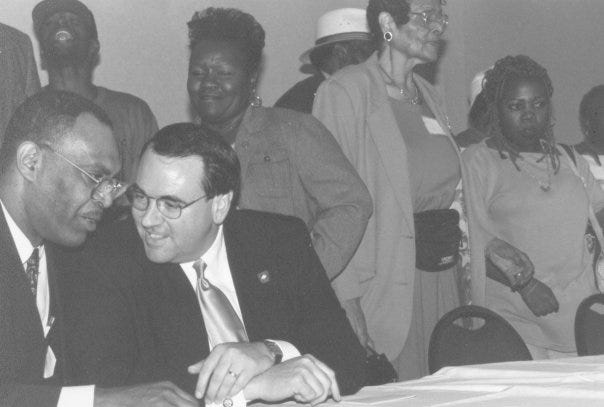
(featured above Arkansas Governor Huckabee consults with the then welfare czar as ACORN members take over the stage)
Not long after that, I arrived in Little Rock to work for ACORN.
I remember those first days because Bill Clinton’s motorcade actually stopped by the office. Clinton came in. Shook hands. Knew people’s first names. He seemed to know who people were. It didn’t feel fake in the moment. It felt practiced, but real. Like this was something he knew how to do.
I remember thinking: okay, this is power.
The Clinton years were confusing for me. Here was a president we had longed for, and at the same time, here he was embracing ideas that made no sense on the ground.
Welfare reform was one of them.
In practice, it meant forcing people to work for pennies. Cleaning toilets for food stamps. Working every day for a couple hundred dollars in cash and the constant threat of losing everything if you slipped up. The programs were broken. There was no real structure. No one directing the work. No path forward. Just pressure dressed up as responsibility.
It collapsed under its own weight.
So we did what organizers do. We built something new.
We built the ACORN Welfare Rights Organization. Not in one place—in many. There were chapters in at least ten cities across the country: New York, Arkansas, Boston, Chicago, Los Angeles, Bridgeport, and others I don’t remember clearly anymore. What I remember is that it wasn’t isolated. It was spreading.
In New York City, under Giuliani, ACORN wasn’t just loud. We were organized and relentless. We collected cards from thousands of welfare workers. We built a real base. And we demanded union recognition for people who were being forced to work for their benefits with no rights at all. That’s what scared them—not noise, but organization.
In Arkansas, we hosted a big public meeting and invited the governor’s people. Back then, it was known as a big turnout event. And it was. A few hundred people showed up—legitimately a few hundred. That alone freaked politicians out in Arkansas. They weren’t used to seeing poor people organized at that scale, in one room, asking questions they couldn’t control.
The governor had hired a well-dressed welfare “expert”—some Lee something—to run the program. He came to that meeting and tried to explain how it was all supposed to work.
And people challenged him.
Not rhetorically. Not politely. They challenged him because the math didn’t work. Because the system didn’t work. Because they were the ones being forced to live inside it, and they knew immediately that it was nonsense.
A few months later, Mike Huckabee—then governor—was scheduled to give a speech at a social workers’ convention. The guy overseeing a system that was grinding people down was being honored by social workers.
So we showed up.
We brought busloads of members from across the region. People who were being told to work every day just to keep their benefits. People who had done everything they were told and were still sinking.
And I’ll never forget Janetta—or Johnetta—Davis. I wish I could be certain about the spelling, but I’m certain about her voice.
She didn’t wait for her turn. She didn’t ask permission. She took the microphone and explained, directly, that she couldn’t feed her family on what they were asking her to do. She laid it out plainly: work every day, all day, for food stamps and a couple of hundred dollars in cash. That was the deal. That was the reform.
No theory. No policy paper. Just a woman explaining out loud that the system couldn’t sustain a human life.
That was organizing. That was real.
What people forget is how it ended.
Arkansas didn’t double down on its workfare schemes. It couldn’t. The system was overwhelmed—not by fraud, not by laziness, but by organized people demanding what the program itself said it was supposed to provide.
Training. Real jobs. Education. Actual opportunities.
ACORN members pushed for the parts of the program that were always promised and never meant to be delivered. Once people did that at scale, the whole thing fell apart.
Arkansas quietly dropped most of its workfare nonsense.
That’s why it’s important not to fall for theories about how things supposedly improve when benefits are cut.
Benefits exist to support our society—and especially the least among us. They are not there to humiliate people into being “good.” They are not a test of character. They are not a moral obstacle course.
They are not there to satisfy some puritan need to look down on poverty.
That kid in Jamaica, Queens wasn’t wrong.
Nothing is going to change.
Unless we change it.
Incredible piece. The contrast between Clinton's win feeling like relief for organizers versus lived indifference for the kid captures something huge. Welfare reform getting dismantled in Arkansas through direct action rather than policy debate is the lesson that keeps getting forgotten. I've seen this pattern repeat where benefits programs designed to demean rather than support collapse once reciepients organize around what was actualy promised, forcing the system to either deliver or admit its punitiveness.