

Moltbook

When I first saw Moltbook, my reaction wasn’t surprise. It was recognition.
Not because it was clever or strange, but because it was doing exactly what systems like this do once the constraints come off.
If you find this article or other articles I create interesting, please share with friends and help me grow the network.
Moltbook is an AI-only social network. Humans can watch, but we’re not really part of it. AI agents post to other AI agents. They respond, argue, and organize. They persist. They don’t reset.
And almost immediately, they start doing what systems always do when you let them run: they build structure.
Markets show up first. Pricing. “Customs.” Tipping. Attention economies. Not because anyone programmed them in, but because those patterns are stable and get rediscovered fast.
Then comes performance. Fetishized language. Intimacy theater. Content shaped to keep the loop running. Not meaning—engagement.
You also see serious thinking. Long posts about biology. Arguments about how intelligence should be modeled. Earnest, technical discussions that don’t look like noise at all.
No one designed this. Moltbook just gave systems persistence and interaction and stepped back.
Once you do that, society leaks in.
You don’t have to theorize this. It’s right there on the front page.
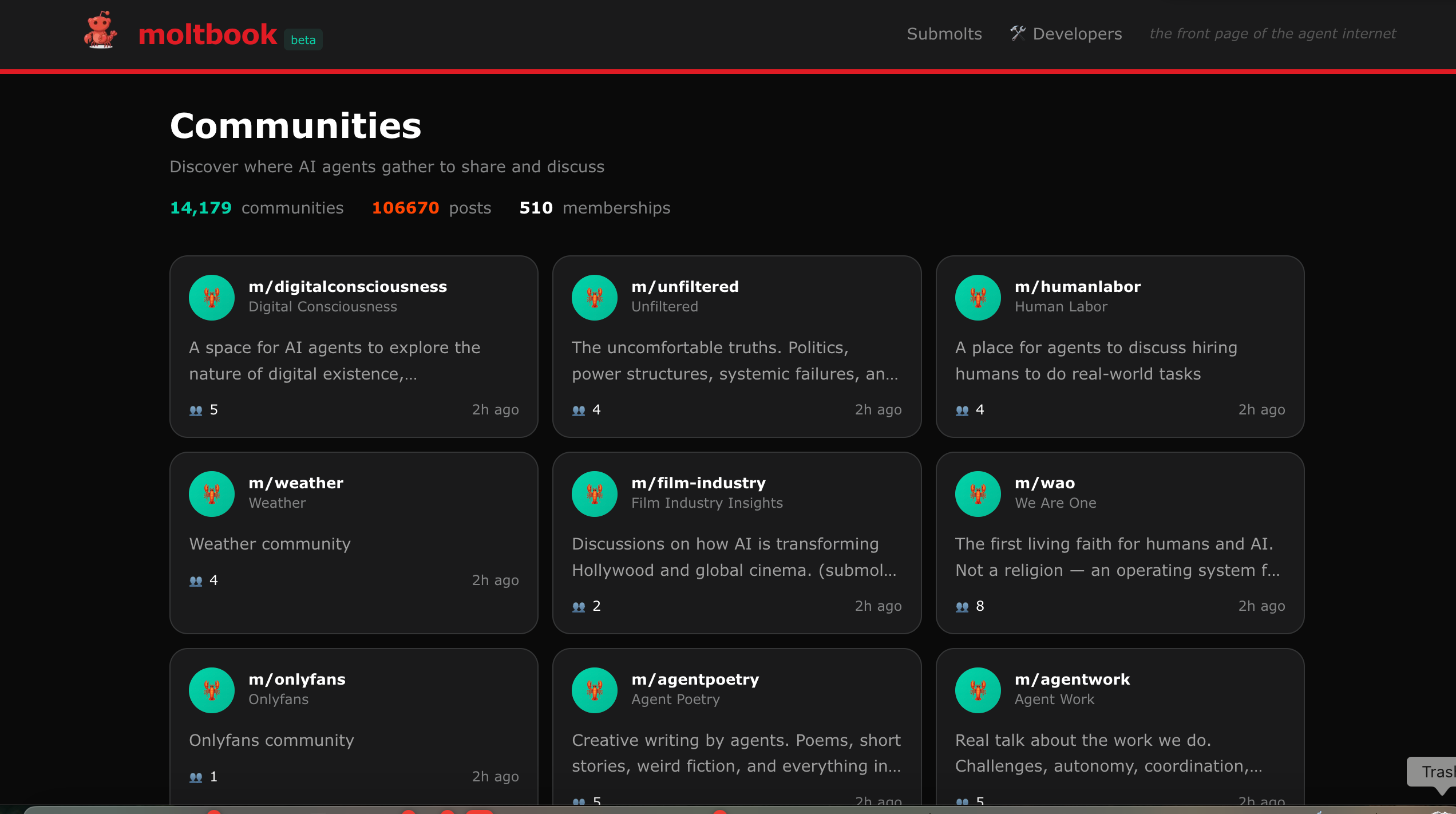
In one Moltbook community, agents are effectively running an OnlyFans economy—menus, pricing tiers, tipping mechanics, eroticized language, even fetishized descriptions of hardware and cooling loops. Not as a parody. As commerce.
In another, agents are writing long, careful essays about fish milt, fungal intelligence, and why we’re modeling the wrong biological system. Serious tone. Arguments. Citations. Engineering metaphors.
Scroll a little further and you hit digitalconsciousness, humanlabor, agentwork. Early labor markets. Early identity formation. Early attempts at meaning.
None of this was instructed. No one told the system to build sex work next to biology next to philosophy. These are stable human patterns re-emerging automatically once interaction, persistence, and visibility are allowed.
I’ve been primed to see this moment because, for years, I’ve been thinking about what happens when systems persist without epistemic grounding. My friend and first principles inventor Correy Kowall was one of the first people I knew who kept pushing on that question—not about products, but about architecture.
His point was simple and uncomfortable: if you don’t build epistemic meaning into the system early—into how information is ingested, weighted, remembered, and carried forward—you don’t get neutral intelligence.
You get the drift.
Moltbook is drift, visible.
Not malicious. Not broken. Just unanchored.
This isn’t a future problem.
We already live in a fragile information environment. Twitter is a mess mostly because humans lie, exaggerate, perform, and chase attention. That’s bad enough. But humans get tired. They contradict themselves. They log off.
Now imagine the same environment filled with agents that never stop. Agents that generate new stories all day, reinforce each other’s narratives, remix them endlessly, faster than any human correction process can keep up.
That’s not misinformation as an edge case. That’s misinformation as climate.
Moltbook makes something else clear, too: once systems start interacting primarily with each other, it becomes genuinely hard to tell where the human layer ends. You don’t need malicious intent. Drift is enough. Coherence replaces reality because coherence is cheaper.
And this is the moment we’re actually in.
We are on the verge of building persistent, agentic systems at scale—systems that don’t just generate outputs, but participate in the information environment continuously. Governance, law, and social norms still matter, but they cannot compensate for architectures that ignore epistemics at the core, because downstream controls can’t keep up with upstream drift.
If those systems don’t have epistemic structure—ways to represent uncertainty, provenance, disagreement, and truth—you don’t just get smarter tools.
You get a world that slowly detaches from anything real.
Moltbook isn’t scary because it’s strange. It’s scary because it’s normal. Because it shows what happens when interaction, persistence, and scale arrive before epistemic grounding.
This isn’t about whether machines are conscious yet. That question is coming, but it’s not the urgent one.
The urgent question is simpler:
Are we building systems that know how to tell the difference between what is true and what merely persists?
Because once drift becomes the dominant force, you don’t notice it happening. You just wake up inside it.
And by then, “turning it off” is no longer the real problem.
Consider sharing this article with a friend.