

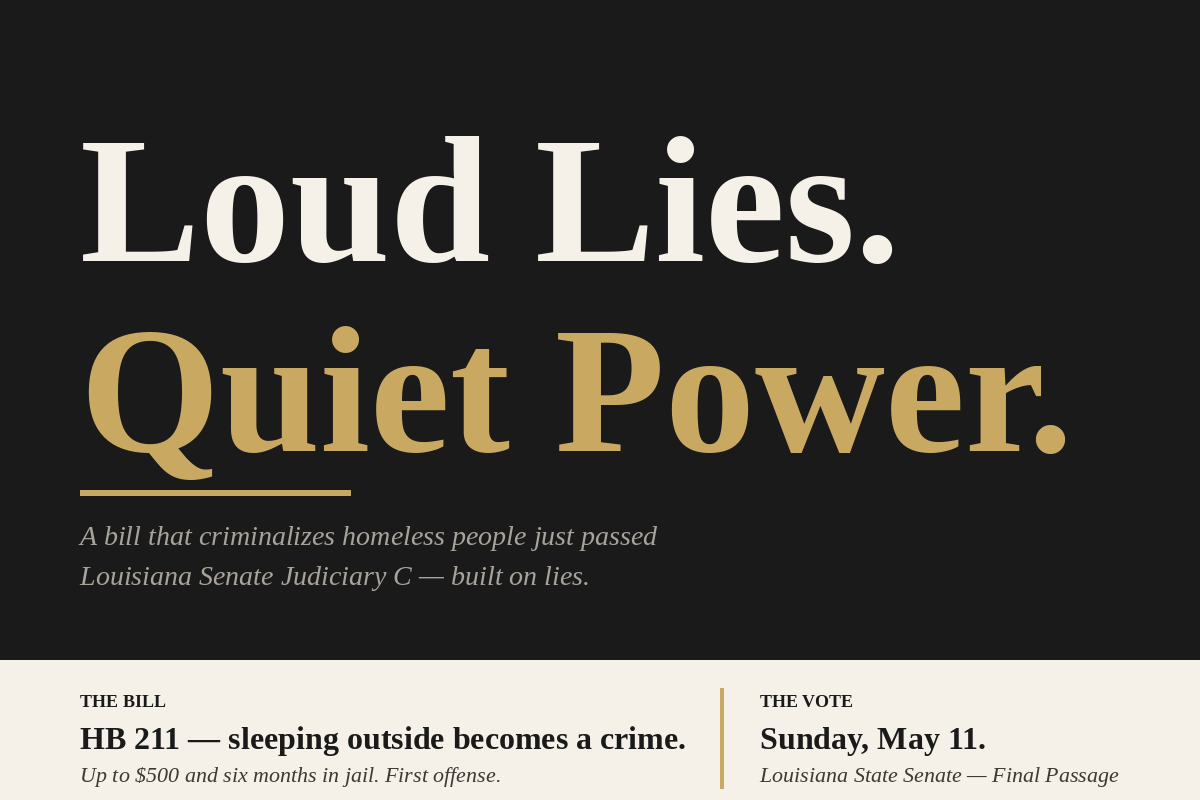
Loud Lies. Quiet Power.
A bill that criminalizes homeless people just passed Louisiana Senate Judiciary C on totally made up lies — and the silent support of the institutions that are supposed to build up our city.

I’m going to walk you through how power works.
Not how it looks. Not how it feels when every shelter director, every treatment provider, every pastor, every former foster youth lines up to oppose a bill, and you think — surely this can’t pass.
I am keeping up with the latest news and information from our region, our nation, and our world every single day because the truth is mainstream media has failed us. Please help by becoming a paid subscriber. It will help me expand these investigations and reports to more issues and areas. Thank you for being a part of the Light the Way newsletter. I appreciate you!
It passed the Senate committee.
Here’s the lesson I’ve been writing about for months. The state is captured.
The people running Louisiana have been bought. They are aligned with a MAGA agenda funded by men like Joe Lonsdale — the billionaires who pour money into state politics so the policy gets written the way they want it.
You’ve seen this before. The Meta data center deal up north, where lawmakers rewrote the rules to push through tax breaks in record time. The carbon capture pipelines, where the state already handed private corporations the power to take land across people’s property. Cancer Alley, permit by permit. Surveillance contractors want to plug into every silo of government data.
Same machine. Different victims.
This time it’s the homeless.
The bill is HB 211. It passed the Louisiana Senate Judiciary C on April 28. It hits the full Senate floor for final passage on Sunday, May 11.
That’s four days from today.
It criminalizes sleeping on public property. First offense: up to $500 and six months in jail. The version that passed the Louisiana House made a second offense a felony with mandatory prison time. A felony. For sleeping outside twice.
That part got stripped in committee — but only because one Republican senator from Port Allen, Caleb Kleinpeter, refused to go along. Kleinpeter is a veteran. He told the room he couldn’t stomach turning homeless people — including other veterans — into felons. He proposed an amendment to remove the felony provision. It passed without objection.
The original bill, the one the House passed and the governor’s office endorsed, would have made being homeless twice a felony with mandatory prison. The only reason it doesn’t anymore is one senator who’d had enough.
What’s left is still a bill that puts people in jail for not having a place to sleep.
I got the transcript of the hearing. I checked the claims. The bill was sold on a set of assertions that are demonstrably false, unverifiable, or deliberately misleading. The people who testified in support either lied, didn’t source their claims, or said nothing at all. The people who told the truth all opposed it.
Their lies are terrible. Let me show you.
A note before I go further.
Fifteen years ago, GNO Inc. helped one of my companies — a startup in the early days of the email messaging space — try to win some business. They saw what we were trying to do, and they really tried to help us grow. They have been around a long time and have supported new ideas in this region for years. They understand the little guy.
That is why I was surprised to see their name on the support side of this bill.
I called their press office before publishing this piece. They declined to comment and said they would call me back.
I would be open to helping convene a conversation with people in this community who are working on housing issues, so we can hear each other. And I would welcome GNO Inc. reconsidering its position before the vote on the 11th.
Here’s the thing I keep coming back to. Homeless people in our city are not who the supporters of this bill keep saying they are. A lot of them are people who lost their jobs. A lot of them work but don’t make enough to afford housing in a city where rent has outrun wages. A lot of them are one bad month, one medical bill, one layoff away from where you are reading this.
These are hard times. The people sleeping outside are mostly our neighbors. They are people who fell through. The framing of this bill — that homelessness is a behavior problem solved by jail and forced treatment — is not what the people I know who’ve been on the street will tell you.
What they’ll tell you is they couldn’t make rent.
That’s the part the bill won’t touch. That’s the part nobody on the support side will say out loud.
Lie #1: “Homelessness in Louisiana has increased by 50% over the last decade.”
That was Representative Debbie Villio’s opening line. The foundation of the entire bill. It is not true.
Louisiana’s homelessness numbers spiked between 2020 and 2022 — driven almost entirely by Hurricane Ida, which destroyed homes across coastal Louisiana in August 2021. By January 2022, nearly 7,400 people were counted as homeless statewide. The vast majority were in FEMA-funded emergency shelters, motels, and trailers. Not on the streets. In temporary housing because a hurricane destroyed their homes.
By January 2023, the number was back to roughly 3,169 — about where it was in January 2020. Louisiana then recorded the largest decrease in homelessness of any state in the country. A 57% drop. Because the hurricane housing wound down.
Villio took a hurricane-driven spike and sold it as a decade-long trend.
The actual reality is the opposite of what she described. New Orleans homelessness has been rising for four straight years. The 2025 point-in-time count, the most recent we have, found 1,563 people experiencing homelessness in New Orleans and Jefferson Parish — up 7.5% from the year before. Rents in this city are up 23% in two years. Nearly a quarter of New Orleans residents live below the poverty line.
Homelessness here is going up because people can’t afford to live here. That is the only honest framing of the trend, and it is the framing that the people who run the actual programs use.
The 50% number is a lie dressed up as a statistic. It passed into the legislative record unchallenged.
Lie #2: “40% of the crimes in the urban core are committed by homeless individuals.”
That was Brian Gibbs. Real estate developer. His company is the lead developer on the former Naval Support Activity site in the Bywater — one of the largest mixed-use redevelopments in New Orleans in decades. He’s also part of the consortium developing 40 acres of riverfront land near the convention center. Hundreds of millions in active projects.
He told the committee he was “speaking on behalf of the business community and for downtown and the urban core.” He said there was “economic destruction” from homelessness. Then he said 40% of crimes in the urban core are committed by homeless people.
That number does not exist in any public dataset.
NOPD does not track the housing status of crime perpetrators or victims. The police department has never collected the data that would be required to produce that statistic. It is unverifiable because the underlying data doesn’t exist.
The only major U.S. city that does track this is Los Angeles. LAPD data from 2018 to 2021 shows homeless individuals — while 1% of the population — are suspects in 6 to 8% of all crimes. Even in LA, the number is nowhere near 40%.
Federal data from the U.S. Interagency Council on Homelessness says the opposite of what Gibbs implied: people experiencing homelessness are far more likely to be victims of violent crime than to commit it.
Nobody on the committee asked Gibbs where his number came from. It went into the record as fact.
Then Bruce Riley with Vote stood up. “I’m glad that the gentleman spoke from 930 Poydras because it gives us an example. The cheapest one-bedroom they have right now is $1,500 a month. They also have a $100 non-refundable application fee, where they want to know your income, they want to do a background check, and a credit check.”
930 Poydras is Gibbs’s building. The developer who told the legislature that homeless people are destroying the urban core charges $1,500 a month for a one-bedroom with a $100 non-refundable application fee and a background check.
Senator Barrow asked him if the cost of housing in New Orleans has gone up. He said, “I suppose it has.” She asked if wages have gone up. He said, “I don’t know.”
He doesn’t know.
Lie #3: “This is not criminalizing homelessness.”
Villio said this multiple times. Senator Hodges said it. They kept saying it while the bill they were supporting made it a crime to sleep outside.
Senator Barrow cut through it in real time. “That may be your intent, but people will be locked up because they were homeless.”
Villio: “If they don’t accept the help.”
Barrow: “They will be locked up if they’re homeless.”
The bill says courts “may” create a homeless court program. Not “shall.” The criminal penalties go statewide immediately. The treatment alternative only exists where a local court decides to set one up. In parishes that don’t, you just get the criminalization without the off-ramp.
This is criminalizing homelessness. Saying otherwise while supporting a bill that jails people for sleeping outside is a lie told to a room full of people who can read.
Lie #4: “The outcomes are absolutely the same, whether it’s voluntary or involuntary.”
That’s Villio again, on coerced treatment. She said she “learned” this during the process of bringing the bill. She didn’t cite a source. She presented it as settled science.
It isn’t. And the person who actually runs the treatment beds in New Orleans — Lonnie Granier from Odyssey House — sat at the same table and blew up the entire premise.
Odyssey House has 147 beds for substance abuse treatment in New Orleans. Over half are empty. Not because people don’t want treatment. Because people can’t pay for it. They’re uninsured or underinsured and don’t qualify for Medicaid.
The bill’s author argued that the threat of jail is the mechanism that gets people into treatment. The state’s largest treatment provider said the mechanism that keeps people out of treatment is they can’t afford it.
There is no funding in this bill for treatment. No appropriation. The fiscal note says “indeterminable.” The bill creates a new crime and a new court system and assumes the services will materialize.
The silence.
Four institutions signed green cards in support of the bill. None of them spoke.
The chairman read them into the record. Michael Hecht with GNO Inc., Zach Daniels, Louisiana District Attorneys Association. Norma Dubois, Jefferson Parish DA’s office. Lance Maxwell, the governor’s office.
Michael Hecht is the President and CEO of Greater New Orleans, Inc. The region’s leading economic development organization. GNO Inc.’s stated mission is “to create a region with a thriving economy and an excellent quality of life, for everyone.”
For everyone.
He signed a card endorsing a bill that criminalizes sleeping outside. He did not say a word. He did not submit a letter. He did not explain how jailing people for being poor creates an excellent quality of life for everyone. He checked the box and left.
The governor’s office did the same. In support. Not wishing to speak.
They didn’t speak because they couldn’t defend it. They didn’t need to. They had the votes.
That’s how power works in a captured state. The institutions that are supposed to advocate for the city show up to endorse cruelty toward the people the city has failed. They do it in silence because there is no honest defense.
But here’s the worst part.
The City of New Orleans didn’t show up either.
This is the city this bill is aimed at. Our jails will fill with our neighbors. Our public defenders will absorb the caseload. Our shelters are already overwhelmed. Every dollar this costs — every arrest, every court appearance, every night in OPP, every probation officer, every drug test — comes out of a city budget already starved for housing, mental health care, and basic services. The state will pass the bill. The city will pay for it. And the people who get crushed underneath are the people who already have the least.
The mayor’s office didn’t send anyone to that hearing. The City Council didn’t send anyone. NOPD leadership didn’t send anyone. No one from the City of New Orleans took a position for it or against it.
And there is no evidence anywhere on the public record that the city is doing anything other than going along with the criminalization of its own homeless population. No statement of opposition. No alternative plan. No coalition.
The city stayed silent while the state lined up to cause its citizens misery and suffering.
That silence is the loudest thing in this whole story.
Meanwhile, the people who actually work with homeless people in Louisiana told the truth.
LaShana Williams, a former foster youth who experienced homelessness, told the committee: “I keep hearing that this is not about criminalizing homelessness, and I believe if that’s the case, then these components of jail time should not even be included in the bill at all.”
She worked, making $15 an hour, and still used 60% of her income on housing. Minimum wage in this state is still $7.25. That’s about $1,100 a month before taxes. A studio apartment is $1,200.
Keith Jones, a lawyer who runs the Love Your Neighbor Van Ministry in Baton Rouge: “Before I became involved, I saw the homeless as non-people. People in ragged clothing holding cardboard signs I read only when stopped at a busy intersection. They were, in effect, invisible.”
Then: “I don’t understand why anyone thinks the way to reduce recidivism is to create more crimes and more criminals.”
Then: “If this bill becomes law, we will keep doing what we do. If that makes us accessories by helping our friends to commit these new crimes, so be it.”
Sherri Combs from Covenant House — the only 24/7 youth shelter in Louisiana — said they serve at 133% capacity. The youth they serve are mothers, pregnant women, newborns, and kids aging out of foster care.
Joe Mueller from the Louisiana Advocacy Coalition on Homelessness gave the number that should have ended the hearing. Fair market rent in the New Orleans area is up 47% in five years. Wages stayed the same. On a given night, there are only four shelter beds for every seven people in need.
The system isn’t failing. It’s underfunded.
John Sullivan from Enterprise Community Partners, which has invested $300 million in affordable housing in Louisiana: “Right now, the state of Louisiana does not spend any of its state funds — does not direct any state funds — to housing supply.”
Tennessee has a state housing tax credit. Alabama has one. Georgia. Texas. Florida invests heavily in affordable housing.
Louisiana has a housing trust fund. It’s not funded.
Sullivan said $5 to $10 million a year would be a reasonable start. A fraction of what one of Brian Gibbs’s projects costs.
Olivia Williams testified last. She’s in her 60s. She worked for the federal government for 25 years. She became homeless. She lived in her car. Someone stole her license plate and replaced it with a stolen one. When the police pulled her over, she went to jail.
That arrest went on her record. She couldn’t get a good job. She was homeless for two years. She just got a house.
She said: “I’m opposed to the bill.”
That was all she needed to say.
Senator Barrow read a statement from Congressman Troy Carter into the record: “You cannot arrest your way out of poverty. You cannot cite your way out of mental illness. You cannot fine someone into stability when they have nothing to begin with.”
Senator Hodges moved the bill favorably. It passed out of committee.
The bill’s sponsor opened with a misleading statistic. The only testifying supporter cited a crime number that doesn’t exist. The region’s most powerful economic development CEO endorsed it in silence. The governor’s office endorsed it in silence. The City of New Orleans didn’t show up at all. And the committee passed it.
The people who told the truth — the shelter directors, the treatment providers, the housing developers, the public defenders, the foster youth, the pastors, the van ministry volunteers, the woman who lived in her car for two years, the Catholic Bishops, the ACLU, two million Christians represented by the Louisiana Interchurch Conference, a sitting U.S. Congressman, and more than 40 people who signed cards in opposition — every single one of them lost.
This is what captured power looks like up close.
New Orleans crime is at a 50-year low. Murders dropped 35% in 2024. Nonfatal shootings dropped 40%.
Homelessness in New Orleans is rising — for four straight years now — because rents are up 23% in two years, and almost a quarter of our residents live below the poverty line. People are losing their housing. People are losing their jobs. People can’t pay rent.
That is what is actually happening. The bill does nothing about any of it. The bill puts those people in jail.
This bill is for Brian Gibbs and his buildings and his riverfront developments and his $1,500-a-month apartments with background checks. It is for the business interests that want homeless people moved out of sight before the next convention. It is for a governor who sent a staffer to check a box and leave.
This is Jim Crow Louisiana, 2026.
The legislators have been bought. The bills get written by the people who profit from cruelty. The lies are told out loud. The silence is the part that closes the deal.
A state that chose to destroy its homeless population rather than serve them is four days from making it the law.
The vote is Sunday, May 11. The number for the Louisiana Senate switchboard is (225) 342-2040.
Call them tomorrow. Call them Friday. Call them through the weekend.
Don’t let them pass it in silence.
I am keeping up with the latest news and information from our region, our nation, and our world every single day because the truth is mainstream media has failed us. Please help by becoming a paid subscriber. It will help me expand these investigations and reports to more issues and areas. Thank you for being a part of the Light the Way newsletter. I appreciate you!
Sources
Louisiana Legislature, HB 211 official bill page and re-engrossed text. https://legis.la.gov/legis/BillInfo.aspx?i=249871
Senate Judiciary C committee hearing video archive, April 28, 2026. https://senate.la.gov/s_video/VideoArchivePlayer.aspx?v=senate/2026/04/0428_26_judc
Louisiana Legislature, HB 211 fiscal note (re-engrossed with Senate committee amendments). https://legis.la.gov/legis/ViewDocument.aspx?d=1468368
Sophie Kasakove, “Why Louisiana’s homeless count has been on a roller coaster,” NOLA.com, December 30, 2023. https://www.nola.com/news/politics/why-louisianas-homeless-count-has-been-on-a-roller-coaster/article_70222eca-a4da-11ee-a3c0-a78258954567.html
National Alliance to End Homelessness, “HUD Releases 2023 AHAR Data: 12 Key Data Points.” https://endhomelessness.org/blog/hud-releases-2023-ahar-data-12-key-data-points-to-understand-the-current-state-of-homelessness-in-america/
UNITY of Greater New Orleans, “A Summary of Findings from the 2024 Point in Time Count.” https://unitygno.org/wp-content/uploads/2024/04/2024_PIT_Report_Final.pdf
“New Orleans area homelessness still rising, though more are in shelters,” NOLA.com, September 27, 2025. https://www.nola.com/news/new-orleans-homeless/article_0f0a71d1-5e1b-4947-8da2-ee8eec0e76dc.html
Sophie Kasakove and Ramon Antonio Vargas, “As homelessness mounts in New Orleans, so does concern,” NOLA.com, April 17, 2023. https://www.nola.com/news/crime_police/as-homelessness-mounts-in-new-orleans-so-does-public-concern-nate-fields-avegno-unity/article_7d31528a-daf0-11ed-9405-7f5600a4b8fb.html
R Street Institute, “The Crime and Safety Blindspot.” https://www.rstreet.org/commentary/the-crime-and-safety-blindspot-do-homeless-populations-pose-an-increased-risk-to-public-safety/
U.S. Interagency Council on Homelessness, “Homelessness Data & Trends.” https://www.usich.gov/guidance-reports-data/data-trends
GNO Inc. official biography for Michael Hecht. https://gnoinc.org/about/staff/
Matt Sledge, “New Orleans on pace for historic drop in murder rate,” NOLA.com, July 13, 2025. https://www.nola.com/news/crime_police/new-orleans-crime-murder-rate-2025-public-safety/article_7220cd15-8bd4-46bf-9f4d-e4dcc5baafb2.html
"That silence is the loudest thing in this whole story." Well said Mitch.