

Grades Are Posted
GNOHA just graded every candidate running in the May 16 primary on housing. The results say everything about Louisiana politics.

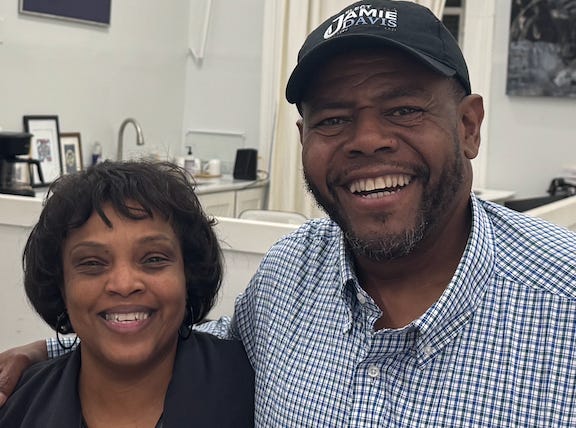
I’ve been an organizer for a long time. You learn who’s real.
In this work, there are people who get respected — not because they’re easy to deal with, not because they go along to get along. They get respected because they bring up the hard issues when everyone else wants to move on. They focus on expanding the community of people actually doing things. They insist on good, detailed policy — not talking points, not slogans, but the kind of specifics that make politicians uncomfortable.
Andreanecia Morris is one of those people.
She grew up in Edgard, Louisiana — the parish seat of St. John the Baptist Parish, about 30 miles upriver from New Orleans on the west bank of the Mississippi. Population under 2,000. Sugar plantation country turned river parish quiet. The kind of place where the Catholic church gave the parish its name and everybody knows everybody. She studied mass communications and sociology at Loyola. Before she became one of the most important housing advocates in the state, she wanted to work in television. “Before there was a Shonda Rhimes,” she told Gambit in 2018, “I wanted to be a Shonda Rhimes.”
Instead, she spent nearly a decade at the Housing Authority of New Orleans, then helped build the Greater New Orleans Housing Alliance — GNOHA — which was incorporated in 2012 as a collaborative of nonprofits trying to rebuild a drowned city’s housing stock. After Katrina, GNOHA helped 500 families become first-time homebuyers. Morris built the HousingNOLA 10-year strategy that identified the need for 33,600 affordable housing units. Under her leadership, GNOHA’s members and partners created roughly 88,000 housing opportunities.
Gambit named her New Orleanian of the Year. JP Morgan Chase named her one of 12 Icons of New Orleans.
She doesn’t bring that up. She brings up insurance rates.
I write this newsletter because I spent my life learning how power works — as an organizer, as a business owner, as a creator. And the thing I learned is that power works the same way everywhere. It’s organized money, organized people, and organized institutions. That’s it. Whether you’re knocking on doors in Little Rock or sitting across from a politician in New Orleans or trying to build something from nothing — the mechanics are the same.
If that’s useful to you, subscribe. If you’re already here, share this with someone who needs it.
This week, Morris and GNOHA released the 2026 #PutHousingFirst Candidate Scorecard — their grading of every candidate running in the May 16 primary. Senate. Congressional districts. Public Service Commission. BESE.
Here’s how it works.
GNOHA sends every qualified candidate a detailed questionnaire on housing policy. Then they invite each one in for an interview — not with staff, but with a committee of community members. Real people. People who live with the consequences of housing policy every day. They sit across from the candidates and ask questions about insurance, about utilities, about homelessness, about what it actually costs to keep a roof over your head in Louisiana.
The candidates who show up, answer the questions, and demonstrate they understand the issues — they get graded on both the questionnaire and the interview. The ones who fill out the paperwork but won’t sit down with the community? The best they can get is a C. The ones who ignore the whole process? They get an F.
Incumbents face an extra layer. Their record in office gets weighed against their words. You can say whatever you want on a questionnaire. The committee wants to know what you actually did.
GNOHA has been running this since 2017.
The scorecard moves votes.
And some candidates — some of them returned to refine their answers, to change their minds after sitting with the community. That’s the part Morris wants people to understand. The process isn’t just about grading. It’s about accountability. It’s about giving regular people the platform to look a politician in the eye and ask: " Do you understand what’s happening to us?
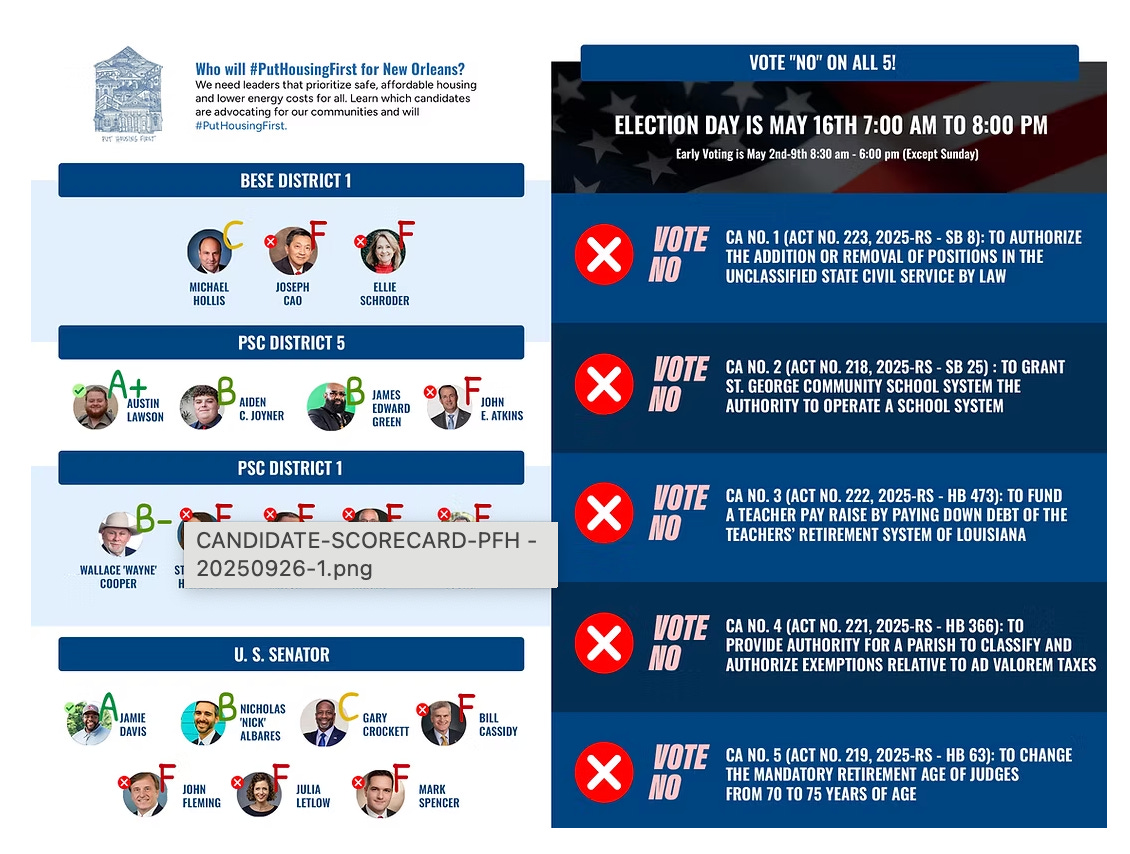
In the U.S. Senate race this cycle, only one candidate earned an A.
Jamie Davis. A third-generation row crop farmer from Waterproof, Louisiana. Tensas Parish. He grows sorghum, corn, soybeans, and cotton on more than 2,000 acres — land that includes acreage his grandfather worked as a sharecropper. He served as a Police Juror, ran for State Representative, and launched his Senate bid last December.
His slogan is “build a Louisiana we can all afford.”
Davis completed the full questionnaire. Sat for the interview. Demonstrated that he understands housing isn’t a side issue — it’s the foundation underneath everything else. The rest of the field, across both parties, scored lower or didn’t show up.
Morris wanted me to be clear about something: this is not a partisan operation. GNOHA grades Republicans and Democrats. Republicans came in and sat for interviews this cycle. And GNOHA routinely fails Democrats who are anti-housing or dismissive of poor communities.
“Democrats do that as frequently as Republicans in Louisiana,” she told me. “That’s the reason we’re in this state.”
I asked Morris what her interview committees are hearing. What’s keeping people up at night?
She said insurance three times.
Not because she was being dramatic. Because the crisis hits three different ways.
Insurance is driving up mortgage costs and blocking homeownership. Insurance is preventing people from moving to something better — you can’t afford to make the switch. And insurance is crushing the institutions that hold neighborhoods together. Businesses. Churches. Schools. When your neighborhood church can’t make its premium, that’s not a policy debate. That’s a community coming apart.
But Morris pushed me further. Housing cost isn’t just rent or mortgage. It’s everything it takes to actually live in a house. Insurance. Utilities. Transportation. And right now, every one of those costs is volatile and climbing.
On utilities, she pointed to something that doesn’t get discussed enough: around 70% of Louisiana’s electricity is generated using natural gas. There’s no seasonal escape. Summer, your AC bill destroys you. Milder weather comes, and you think you’ll get relief — but you’re heating your home and cooking your food with the same fuel that’s spiking your electric rate.
There is no break.
Transportation rounds it out. It technically sits outside the definition of “housing cost.” But for the families Morris works with, it’s inseparable from whether you can actually afford to stay where you live.
The Housing First model — get people into stable housing before requiring them to address addiction or mental illness — is under serious attack at the federal level. Morris and GNOHA have watched this fight for twenty years.
Morris was in the rooms after Katrina. She sat in meetings where people debated whether certain New Orleanians deserved help at all. She’s honest about her own evolution — the initial gut reaction of wanting people to get themselves together before they get housed.
The work changed her.
“Whatever you think you know about their trauma — it’s not going to get solved while they’re on the street,” she said. “Why the conditional? Why can’t it be both?”
You want to require mental health treatment before housing? Where’s the mental hospital? You want nursing home care? Louisiana has a moratorium on adding nursing homes because the state can’t regulate the ones it has. As people age out with no savings, with Social Security that covers nothing, the question of where they live becomes a crisis nobody in power wants to name.
And then there’s the legislature that criminalized being homeless.
Morris called that what it is — an economic gambit, not a human one. In a state where so many people live below the poverty line, where post-Katrina vouchers were the only thing standing between thousands of families and the streets, making homelessness a crime isn’t policy.
It’s a punishment for being poor.
Morris and GNOHA drew a straight line from housing to incarceration.
Louisiana is the most incarcerated state on the planet. Private prisons. Prison labor is a full industry. Profit motive threaded through every part of the system.
“If locking people up made communities safe,” she said, “we’d be the safest place on earth.”
Morris pointed to Amendment Three — the ballot measure voters overwhelmingly rejected this past March — which would have expanded the pipeline of children into the criminal justice system. Sixty-six percent of Louisiana voters said hell no. But the Landry administration keeps pushing. Pro-prison. Pro-lockup. And this is the same legislature that criminalized homelessness in the same session.
Only a handful of legislators are pushing back. A minority within the minority, trying to do the right thing.
GNOHA gives them credit. They want more of them.
I switched to city politics. No city elections right now, but New Orleans is living through something strange — a government that acts like it has no money and then spends like it has plenty.
The city is functioning at a low level right now. And we’re going to pay for it.
Morris agreed. She described leaders who were involved in the decisions that created the financial crisis and now refuse to take responsibility. Six of the city council members from the last four years are still in office. New members came in without experience. And the administration is spending money in ways that defy common sense.
The city asked the state for $5 million. Not for housing. Not for transit. Not for human services. To hire consultants to figure out what to do next.
“That’s crazy,” she said. “These are people who have stayed too long in their jobs.”
And then the hotel. The Convention Center is pushing a $600 million Omni headquarters hotel on Convention Center Boulevard — a 27-story, 1,000-room tower to help New Orleans compete for a 2031 Super Bowl bid. The Convention Center is putting up $80 million in direct public investment, plus a package of tax rebates on hotel, sales, and property taxes that the Bureau of Governmental Research estimated at roughly $669 million over the 45-year life of the deal. A hospitality worker told the board: “Our neighborhoods, our communities, and our working people need a break, not Omni.” Morris pointed out that the Superdome hosted Super Bowls for decades without that kind of subsidy.
A city in financial crisis, subsidizing a luxury hotel for half a billion in tax breaks.
Meanwhile, our workers are furloughed, and non-profits got their grants cut.
The state elections coming later this cycle are going to be enormous. Governor. Treasurer. Insurance commissioner. Every one of those seats matters for housing — and Morris and GNOHA will be there with questionnaires and interview slots and community members sitting across the table.
The insurance commissioner race is the one to watch. GNOHA argues the current commissioner spent his tenure making the market comfortable for insurance companies, not for the families being crushed. The last time the seat was contested, weak opposition meant voters never heard real alternatives. GNOHA wants that to change.
Meanwhile, Jeff Landry’s gamesmanship with the congressional primaries — postponing them to redraw maps, leaving candidates on ballots whose votes won’t count — has added another layer of chaos. GNOHA sees it clearly. Elected officials at the state level don’t understand housing. They’re disconnected from the daily reality of the people they represent.
That’s what the scorecard is for.
Andreanecia Morris — the girl from Edgard who wanted to make television — has been building this infrastructure since GNOHA was incorporated in 2012. The alliance now supports a coalition of sister housing alliances across Louisiana. The #PutHousingFirst campaign has registered thousands of voters.
Last November, GNOHA coordinated the campaign to pass a charter amendment creating a permanent Housing Trust Fund for New Orleans — dedicating 2% of the city’s general fund to affordable housing, every year, in perpetuity. No new taxes. Voters had rejected a housing millage in 2021 when the old fund was controlled by the mayor’s office with no transparency. GNOHA went back to the community, held focus groups, made 18,000 phone calls to renters, and built something better. The amendment passed with over 75% of the vote — a 50-point swing. The National Low Income Housing Coalition nominated GNOHA for a 2025 organizing award on the strength of that campaign.
The first allocation hit in January 2026. It was supposed to be $17 million. It came in at $14.6 million — because the city is staring at a $100 million deficit and the mayor proposed an 11% budget cut. The need keeps growing. New Orleans now requires 55,000 new affordable units, up from 47,000 last year. The city created 435 new housing opportunities in the past year.
The trust fund exists because GNOHA organized it. But it’s already being squeezed by the same city government that can’t stop spending money it doesn’t have.
That’s what real organizing looks like. You lose, you listen, you rebuild, you win. And then you fight to protect what you won.
Morris and GNOHA ask the questions nobody else is asking. They sit community members in front of politicians and let them ask the questions. And they publish the grades.
The 2026 scorecard is live at puthousingfirst.org. The May 16 primary is eleven days away.
Most of the candidates aren’t passing.
The ones who didn’t even show up got exactly the grade they earned.
Sources and Citations
Andreanecia Morris biographical details, Edgard upbringing, Shonda Rhimes quote, HANO career: Gambit, “New Orleanian of the Year 2017: Andreanecia Morris,” January 2, 2018
GNOHA founding, incorporation in 2012, Morris as lead organizer, 88,000 housing opportunities, 500 first-time homebuyers: HousingNOLA, About Us
Morris’s education, Edgard native: Gov. Edwards Appoints Andreanecia Morris to Louisiana Housing Board, NCSHA, 2017
Icons of New Orleans, Gambit New Orleanian of the Year, Federal Reserve appointment: GNOHA Board of Governors
#PutHousingFirst scorecard methodology, grading process, history since 2017: Put Housing First, Elections
2026 #PutHousingFirst Candidate Scorecard: Put Housing First, Elections 2026
Jamie Davis background, campaign, platform: Ballotpedia, Jamie Davis (Louisiana)
Jamie Davis profile: Louisiana Illuminator, “’I’m a country boy’: Farmer Jamie Davis goes grassroots to mount US Senate challenge,” April 30, 2026
Louisiana electricity generation, ~70% natural gas: Louisiana Illuminator, “Louisiana’s LNG export boom will fuel higher electricity costs,” December 19, 2025
Amendment Three rejected by 66% of voters, March 29, 2025: Louisiana Illuminator, “Louisiana voters reject 4 constitutional amendments,” March 29, 2025
Housing Trust Fund charter amendment, passed with over 75%, 18,000 phone calls, 50-point swing, NLIHC 2025 organizing award nomination: NLIHC, “NLIHC Recognizes Greater New Orleans Housing Alliance as an Organizing Awards Nominee,” March 13, 2025
Housing Trust Fund approved by voters, $17M annually, 2% of general fund: WWNO, “New Orleans voters approve affordable housing trust fund,” November 6, 2024
Housing Trust Fund 2026 budget at $14.6M, $100M city deficit, 11% budget cut proposed, 55,000 units needed, 435 created: NOLA.com, “New Orleans sets plan for new $14M Housing Trust Fund,” October 7, 2025
Edgard, Louisiana history and description: Wikipedia, Edgard, Louisiana
Omni headquarters hotel, $600M project, $80M public investment, tax rebate package: NOLA.com, “Board approves tax zone for convention center headquarters Omni hotel,” March 26, 2026
BGR analysis, $669M in net tax rebates over 45 years, recommendation to reduce subsidies: Bureau of Governmental Research, “Reducing Public Subsidies for New Orleans Convention Hotel,” December 2025
Hospitality worker quote opposing subsidies, PILOT tax incentive details: Verite News, “Convention Center to consider millions in tax breaks for new headquarters hotel,” April 1, 2026